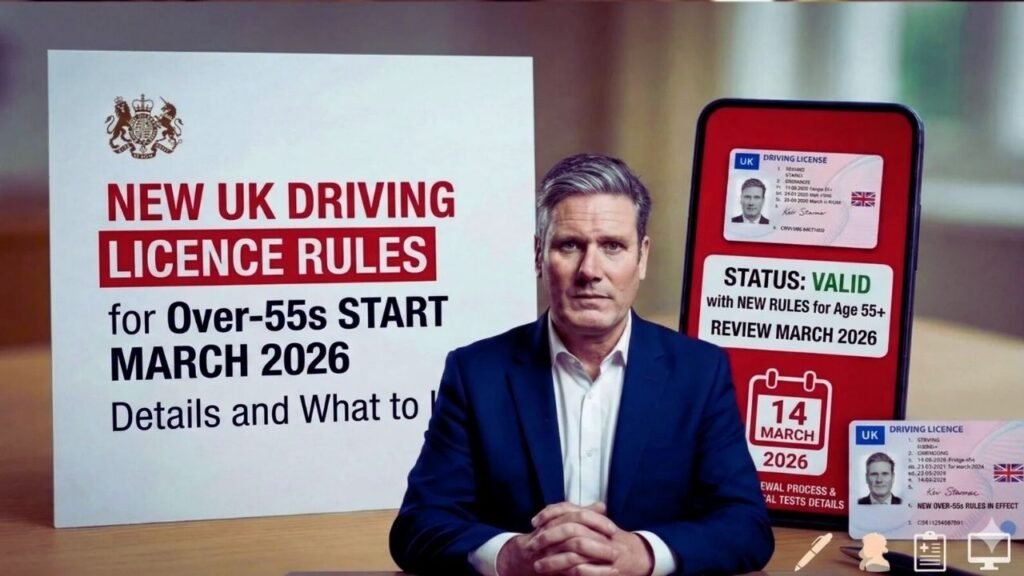
The UK government and the Driver and Vehicle Licensing Agency (DVLA) have released a comprehensive update regarding road safety strategies and licensing requirements for mature drivers. These changes are designed to balance the independence of experienced motorists with the evolving safety standards required for modern road conditions.
Mandatory Eyesight Consultations and New Standards
A central pillar of the March 2026 update is the launch of a formal consultation into mandatory eyesight testing. Currently, drivers in the UK operate on a self-declaration system until the age of 70, where they simply confirm they can read a number plate from 20 meters. However, the new Road Safety Strategy proposes moving away from this honesty-based model.
Under the new proposals, the government is exploring the introduction of compulsory vision checks conducted by certified professionals. This would ensure that every driver on the road meets a baseline clinical standard of vision, reducing the risk of accidents caused by undiagnosed sight deterioration.
- Drivers may soon need an optician’s certificate to renew their licence
- Visual field tests are being considered alongside distance vision checks
- Police powers to conduct roadside “20-meter tests” have been strengthened
- Failure to meet standards can result in an immediate digital revocation of the licence
The Digital Licence Rollout and GOV.UK Wallet
The DVLA has confirmed that March 2026 marks a major milestone in the transition to digital driving licences. While physical plastic cards remain legal and valid, a new digital version is being integrated into the GOV.UK Wallet app. This shift is particularly relevant for those over 55 who may need to update their records more frequently due to health changes.
This digital platform allows for real-time updates to medical declarations and address details. The government aims to have the majority of drivers using the digital system by 2027, which will also provide automated reminders for photocard renewals every ten years—a process that many drivers over 55 often overlook.
Changes to Renewal Cycles and Medical Declarations
While the statutory age for the three-year renewal cycle remains at 70, the 2026 update introduces stricter requirements for self-declaration of “notifiable” medical conditions for those aged 55 and over. The DVLA has expanded the list of conditions that must be reported immediately, rather than waiting for the next renewal date.
- New emphasis on reporting early-stage cognitive changes and sleep apnea
- Stricter penalties for failing to declare a condition that is later cited in an accident
- Faster processing times for medical reviews, now targeted at 50 working days
- Increased coordination between GPs and the DVLA through digital health portals
This move is intended to catch potential safety issues earlier. The government has clarified that declaring a condition does not automatically lead to losing a licence; in many cases, it simply results in a shorter-term medical licence that is reviewed more frequently to ensure the driver remains safe.
Professional and Vocational Entitlements
For drivers over 55 who hold C1 (medium-sized vehicles) or D1 (minibus) entitlements, the 2026 rules clarify the “use it or lose it” policy. Many drivers who passed their test before 1997 hold these categories automatically, but they are often removed upon reaching age 70 unless a specific medical assessment (Form D4) is completed.
The new guidance encourages drivers in their late 50s and 60s to review these entitlements now. If you rely on these categories for voluntary work or larger motorhomes, you must ensure you are prepared for the more rigorous medical standards required to maintain them during your next renewal.
Road Safety Strategy 2026 and Beyond
The 2026 update is part of a broader “Road Safety Strategy” aimed at reducing road fatalities by 65% over the next decade. Beyond eyesight and health, the strategy includes a consultation on lowering the drink-drive limit in England and Wales to align with the stricter standards already in place in Scotland.
For mature drivers, the message from the Department for Transport is one of support rather than restriction. The goal is to provide the tools—such as better health screening and digital reminders—that allow safe drivers to stay behind the wheel for as long as possible while ensuring the safety of all road users.
Frequently Asked Questions
Do I need to retake my driving test at 55?
No, there is no requirement to retake a practical or theory test based on age. The only way you would need to retake a test is if you were disqualified or if the DVLA required an assessment due to a specific medical concern.
Is the mandatory eye test already law?
As of March 2026, mandatory eyesight testing is in the “consultation and implementation” phase. While the government has signaled its intent to introduce it, drivers should continue to follow the current 20-meter self-declaration rule until told otherwise during their renewal.
How much does it cost to renew a photocard at 55?
If you are under 70, the standard renewal fee for a photocard (usually every 10 years) is £14 if done online. Once you reach 70, the three-yearly renewals are free of charge.
Can I still drive while the DVLA is reviewing my medical records?
Under Section 88 of the Road Traffic Act, you can often continue to drive while your application is being processed, provided your doctor has not told you to stop and you meet the specific legal criteria for “fitness to drive.”
What happens if I forget to renew my photocard at age 60?
Driving with an expired photocard is illegal and can result in a fine of up to £1,000. It can also invalidate your car insurance, so it is vital to check the 4b date on your plastic licence.